News

Crane wire failure caused $3.8M in damage to offshore vessels, says NTSB

Crane wire failure caused $3.8M in damage to offshore vessels, says NTSB

Internal corrosion of a crane wire caused US$3.8 million in damage to offshore construction vessel Island Venture and offshore supply vessel C Enforcer at Port Fourchon, according to the National Transportation Safety Board (NTSB).

What happened

On April 3, 2025, about 2145 local time, the offshore construction vessel Island Venture’s crane was being used to lift a wire reel from the back deck of the offshore supply vessel C Enforcer in Bayou Lafourche, Port Fourchon, Louisiana, when the crane’s hoisting wire parted, causing the reel to drop onto the C Enforcer’s main deck. Continue reading “Crane wire failure caused $3.8M in damage to offshore vessels, says NTSB”

Fisherman dies saving fellow deckhand in man overboard emergency

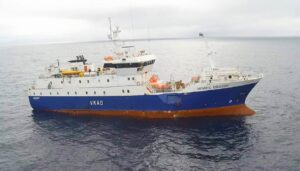
Fisherman dies saving fellow deckhand in man overboard emergency. Weston Bay. Credit: MAIB

Two deckhands went overboard from potting vessel Weston Bay (GY123) off Spurn Head resulting one fatality, an investigation by the UK Marine Accident Investigation Branch (MAIB) found.

The MAIB also released a safety flyer with the investigation report following the incident.

What happened

At about 0820 on 22 May 2024, two deckhands went overboard during deployment of the fishing gear from the UK registered potting vessel Weston Bay while the vessel was shooting its pots approximately 12 nautical miles south-east of Spurn Head, England. The three remaining crew were able to recover one deckhand on board, but their efforts to recover the other deckhand, James (Jimmy) Haughey, were unsuccessful. He was recovered by another vessel about 40 minutes after entering the water; he was not breathing and, despite emergency first aid efforts, could not be resuscitated. The deceased deckhand’s personal flotation device became separated from him during the recovery efforts. Continue reading “Fisherman dies saving fellow deckhand in man overboard emergency”

Safety helmets: When standards fail stevedores and crews

Stock image from Pexels

On 2 May 2019, a twistlock fitted to one of the bottom corner fittings of a container fell out of the fitting while the container was being restowed aboard the container vessel MOL Bravo, in the port of Manzanillo, Mexico. The twistlock landed on the second officer who was on deck, struck his safety helmet and caused fatal injuries.

The investigation report by the Marine Department of Hong Kong noted the following:

  • The second officer failed to follow the company safety procedures to stay away from the hazardous zone underneath the container while it was being restowed by a gantry crane.
  • Although the second officer should not have been standing under a container being loaded onto the vessel, the safety helmet was required to protect him from the falling twistlock. The helmet did not provide adequate protection for this hazard. For those unfamiliar, a twistlock is a steel device inserted into the bottom corner fittings of containers, designed to lock containers in a vertical stack.

Continue reading “Safety helmets: When standards fail stevedores and crews”

DNV interview on cruise ship battery technology

DNV interview on cruise ship battery technology

As cruise operators explore pathways to reduce emissions and improve energy efficiency, batteries are emerging as a pragmatic part of the solution.

DNV has shared a fact-based interview featuring Hilde Bølstad, DNV’s Principal Consultant of Alternative Fuels & GHG Compliance on how batteries fit into cruise vessel design and operation.

Hilde Bølstad is an MSc‑ and BSc‑qualified maritime advisor with 23 years’ experience in ship operations, classification, and surveyor work. Since 2020, she has worked in decarbonization at DNV, supporting shipowners on new regulations and reporting of emissions. In DNV’s Maritime Advisory unit, Hilde works on green‑technology projects for shipping, including alternative fuels, batteries, and shore power. Continue reading “DNV interview on cruise ship battery technology”

Short circuit caused jet boat canyon wall crash in New Zealand

Image credit: Discovery 2 before the fitting of roll bar. Credit: Skippers Canyon Jet Limited, anonymised by the Transport Accident Investigation Commission.

The Transport Accident Investigation Commission (TAIC) has released a report into an incident where several passengers were injured after a jet boat crashed into a canyon wall last year.

What happened

On 25 February 2025, commercial jet boat Discovery 2 was operating in Skippers Canyon, on the Shotover River, with 11 passengers on board.

Shortly after commencing the return leg of the journey, and as the boat completed a right-hand turn, its engine suddenly cut out. The driver immediately reset the ignition, but the engine would not start, so the boat had no propulsion and no thrust to provide steering control. Continue reading “Short circuit caused jet boat canyon wall crash in New Zealand”

Pipe failure cause of Oliver Hazard Perry flooding

Source: Oliver Hazard Perry Rhode Island

A corroded cooling supply pipe caused US$1 million worth of damage to a sailing school ship after the vessel’s engine room flooded, according to the U.S. National Transportation Safety Board (NTSB).

What happened

About 2200 on May 10, 2025, the sailing school vessel Oliver Hazard Perry started taking on water while moored at Fort Adams State Park dock in Newport, Rhode Island. At about 0730 the following morning, a crewmember was awoken by an alarm and discovered the flooding. An estimated 21,000 gallons of seawater entered the engine room and the forward auxiliary machine space. Continue reading “Pipe failure cause of Oliver Hazard Perry flooding”

ITIC warning to marine surveyors following US$30,000 off-spec grain cargo dispute

ITIC warning to marine surveyors following US$30,000 off-spec grain cargo dispute

A US$30,000 off-spec grain cargo dispute claim directed at the wrong surveyor has prompted International Transport Intermediaries Club (ITIC) to warn marine surveyors of the liability exposure they face when the scope of their instructions is not precisely recorded.

A marine surveyor was appointed by the seller of a grain cargo to conduct a joint survey at the load port. The buyer accepted the cargo and subsequently sold it on. At the discharge port, the ultimate buyer and consignee alleged the grain was off-spec due to the presence of ambrosia seed and other impurities. Continue reading “ITIC warning to marine surveyors following US$30,000 off-spec grain cargo dispute”

Engine retrofit market continues to prepare but not fully commit

Engine retrofit market continues to prepare but not fully commit

The future of engine retrofits will depend heavily on regulatory developments says Lloyd’s Register in its latest Engine Retrofit Report.

LR added the longer conventionally fuelled vessels remain in service, the greater the pressure will be to retrofit them later to meet emissions targets, potentially compressing demand into a narrower and more costly timeframe.

The 2026 update shows that 2025 delivered limited growth in announced retrofit projects, but significant progress in capability. Continue reading “Engine retrofit market continues to prepare but not fully commit”

Britannia P&I Club guidance on transporting cement

Correct way of hooking FIPC bags. Source: Britannia P&I Club

The volume of seaborne cement traded continues to grow, with the most recent annual figure estimated to be over 145 million tonnes.

Cement is carried on board ships either in bulk or in bags. And Britannia P&I Club’s loss prevention team has provided guidance on the carriage of cement.

Bulk cement

Risk factors of loading cement in bulk include solidification of the cargo due to water ingress, mainly through hatch covers or the Continue reading “Britannia P&I Club guidance on transporting cement”

Warning sent out on counterfeit GMDSS batteries

Warning sent out on counterfeit GMDSS batteries

The Norwegian Maritime Authority has sent out a warning following a significant increase in the marketing, sale and installation of counterfeit batteries for Jotron GMDSS products in recent years.

Affected products include Emergency Position Indicating Radio Beacons (EPIRB), radar and AIS-SART devices, as well as handheld GMDSS emergency VHF radios. Continue reading “Warning sent out on counterfeit GMDSS batteries”

DNV shares insights into post-fire ship hull structure and material assessment

DNV shares insights into post-fire ship hull structure and material assessment

Fire incidents on ships rank among the most frequent accidents, and in recent years, fire incidents have specially increased among container and ro-ro cargo/passenger ships.

And DNV has supported many cases of post-fire structural and material assessments.

The incidents have ranged from isolated small-scale fires in cargo holds to major fires damaging the complete ship. Continue reading “DNV shares insights into post-fire ship hull structure and material assessment”

IACS publishes recommendation for onboard lifting appliances

IACS publishes recommendation for onboard lifting appliances

IACS, the membership organisation for the world’s leading classification societies, has published a recommendation to improve safety standards for lifting appliances, in line with SOLAS regulations covering both new and existing lifting appliances.

Lifting appliances play a vital role in cargo handling and ship operations, yet their limited structural redundancy has long posed safety risks for crews and vessels. To address these hazards, the International Maritime Organization (IMO) Continue reading “IACS publishes recommendation for onboard lifting appliances”

Instagram Posts from the IIMS @iimsmarine

Privacy Overview

This website uses cookies so that we can provide you with the best user experience possible. Cookie information is stored in your browser and performs functions such as recognising you when you return to our website and helping our team to understand which sections of the website you find most interesting and useful.

Strictly Necessary Cookies

Strictly Necessary Cookie should be enabled at all times so that we can save your preferences for cookie settings.

Show details Hide details
Performance & Marketing Cookies

This website uses Google Analytics to collect anonymous information such as the number of visitors to the site, and the most popular pages. This also helps us optimise our marketing campaigns. User data sent to Google Analytics may be used for ad personalization and measurement of our ad campaigns. Keeping this cookie enabled helps us to improve our website.

Show details Hide details